



Have you ever woken up and the stench of toddler diarrhea hits your nose as if it were your alarm clock?
This was our everyday life for months, and l had a feeling that something was off in my little boy’s body. As an anxious first-time mom, I’ve clung to the advice of medical professionals closely since I found out I was pregnant, but this time, I felt uneasy. My son’s pediatrician at the time was adamant that his diarrhea was normal for a daycare attendee, which I’ve learned can be true, but this time felt different.
That gut-wrenching mom instinct hit me, but I didn’t know what to do.
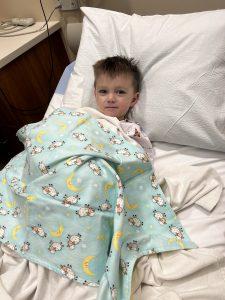
Flash-forward a few months to moving homes and finding a new pediatrician’s office. I let them know that he had persistent diarrhea, and they started a physical examination to find the root of the problem. The pediatrician noticed that my son’s stomach looked bloated and felt firm to the touch. He was also not gaining weight as consistently as he had been before. We were referred to get a stomach x-ray and blood testing to further investigate. My mama heart was aching for my boy. I wanted to take away his pain.
Official Diagnosis
I’m grateful to have cell phone applications that allow us to have our medical records and health information at our fingertips, but that weekend my phone app was not very comforting. BING, BING, BING, BING–was the sound of my boy’s test and x-ray results becoming available for me to view on my phone.
I hesitated to read them because I knew it was a Friday night. If I had any questions, his care team wouldn’t be available to answer them until Monday. I opened the results anyway, and I read, “Celiac Reflex Panel: Normal Range=0.0 – 14.9 U/mL.” Then, I saw the graph that held his results. They read, “>250.0 U/mL.”
There was my mama heart again, racing as I opened the results, and immediately dropping to my toes as I viewed that little dot on the graph that represented antibodies in my boy’s blood. These antibodies indicated Celiac Disease. I can’t lie to you, I cried myself to sleep that night thinking about the changes my son would have to endure. But what exactly is Celiac Disease, I thought. What does this mean for my son’s eating habits? Would I have to change my diet as well? I didn’t know all the answers, but his care team provided many resources for our family regarding our toddler’s newfound autoimmune disease.
Currently
It’s now been a little over a year since his diagnosis, and I’m excited to share what I’ve learned. I am not a medical professional by any means, but I am a mom! The Mayo Clinic has some articles online that helped me build knowledge about Celiac Disease. I like to think of gluten (wheat, barley, and rye) being an enemy to my son’s small intestine. While there is no cure for this autoimmune disease, maintaining a gluten-free diet can reduce symptoms and increase the healing probability of the small intestine. Will my son have an anaphylaxis reaction if he’s exposed to or consumes gluten? No, but if he consumes gluten, his small intestine lining will disintegrate over time. He can be around others eating gluten without any harmful effects, though, which is major for dining out.
I’ve also learned that it’s okay to make my own choices that are different than my son’s. I consume gluten and gluten-free products every day because that is what makes me happy. This teaches my son that he will see others eating foods that are not good for him. He is learning to recognize why he needs to eat things that don’t contain gluten. It helps him advocate for himself at preschool, restaurants, and other family member’s homes. I still can’t believe that at two years old my boy could recognize the “GF” notation on restaurant menus and grocery store labels!
I’m grateful to his former speech therapist from LifeROOTS who focused on my son’s eating habits, like trying new foods. Now, at three years old, he will ask if his food is gluten-free, and that makes my mama heart cry happy tears.

My son may have to explain his autoimmune disease throughout his life, but I’m glad I get to show him how to do that in a positive light. He’ll get to say: “Celiac Disease makes me stronger.” “Celiac Disease taught me how to advocate for myself.” “Celiac Disease helps my body stay healthy.” And . . .
“Celiac Disease is my normal, what’s yours?”
The opinions expressed in this post are those of the author. They do not necessarily reflect the official policy or position of ABQ Mom, its executive team, other contributors to the site, its sponsors or partners, or any organizations the aforementioned might be affiliated with.










Thank you for sharing! This is a good story to share and let people know about.